The Spanish version is the authoritative reference. View in Spanish
Guatemala: Document Reception (MS)
1. XML RECEPTION PROCESS
This process allows different types of documents to be received from customers and suppliers through the channels offered by Gosocket. Once received, both the issuer and the recipient can view the documents in the Inbox Received tray, along with their corresponding graphic representation and attached files.
Likewise, our system performs a series of automatic validations to ensure that the structure and integrity of the information strictly comply with the requirements of the tax authorities.
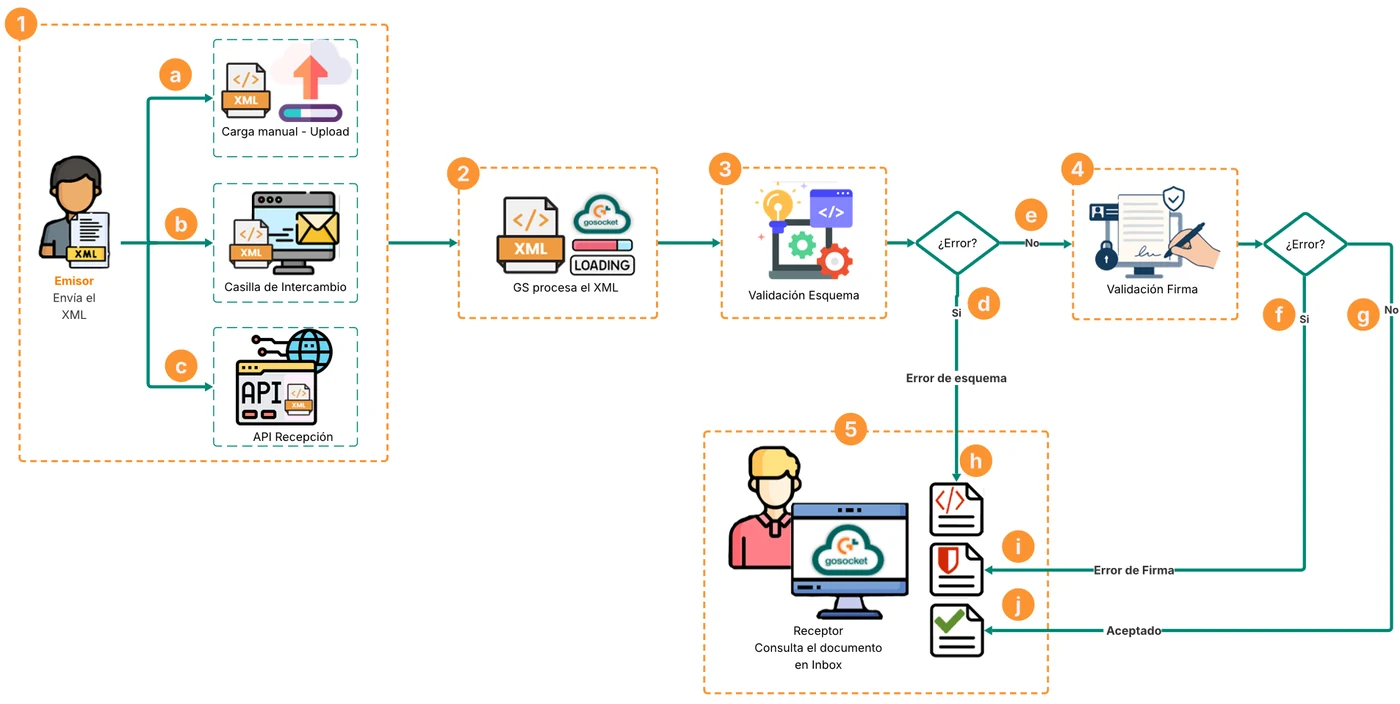
The following image describes, step by step, the document reception flow within the Inbox platform:
Guatemala reception process
1. Methods for sending the XML document in Gosocket:
The supplier can send the XML document to the Gosocket platform in three ways:
a. The supplier manually uploads the XML file using the Upload option in Gosocket. The requirements and conditions for this process are detailed in the section Manual upload.
b. The supplier sends the XML document through the Gosocket exchange mailbox . The requirements and conditions for this process are detailed in the section Exchange mailbox.
c. The supplier uploads the XML document through the Reception API of Gosocket. The requirements and conditions for this process are detailed in the section Reception API's.
Note: When using any of the following document reception channels:
- Exchange mailbox
- Manual XML upload (Upload option)
- Reception API
The system will automatically run the schema, signature, and corresponding validation with the Tax Authority (TA) checks.
2. Reception and validation of documents in Gosocket
The Gosocket portal downloads and processes the XML. When it is a tax document, it enters a reception validation process.
3. Document schema validation
First, a schema validation is performed on the XML document to ensure that it complies with the format established by the tax authority. Depending on the result of this validation, the process can lead to one of the following scenarios:
d. Failed: The document does not comply with the fiscal format, the document reception flow will be stopped due to the schema error, it will be registered in Gosocket with the Schema Error status and the interface will display the icon  and the reason for rejection will be detailed in the document's notes, as follows:

Schema error icon in inbox
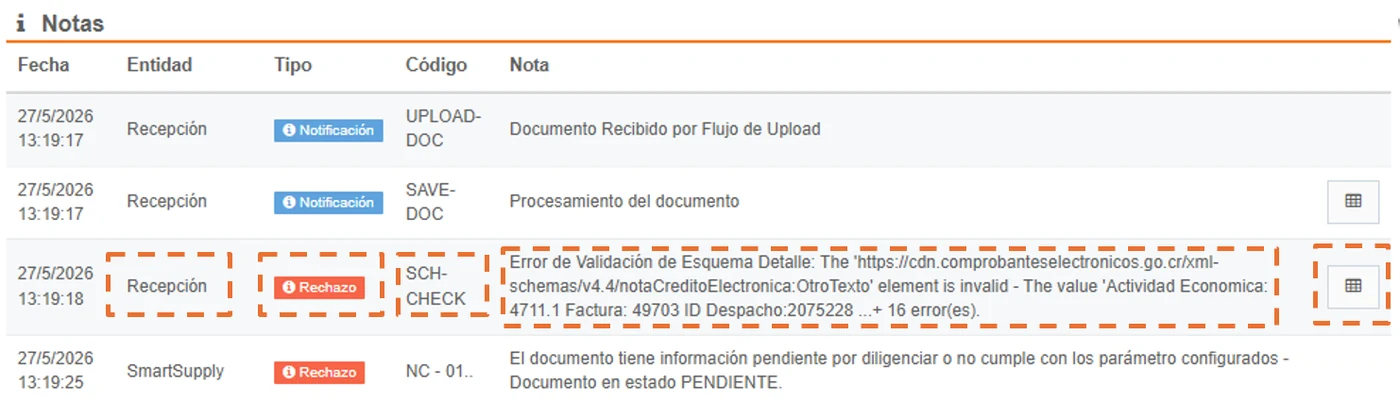
Document detail, Notes section - Schema Error
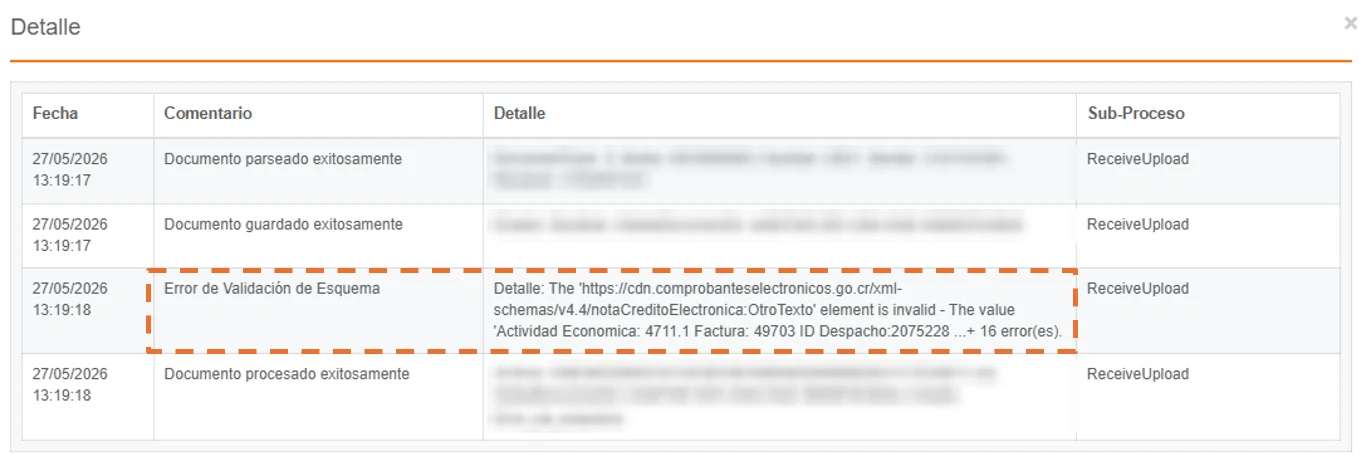
Detail of XML processing for the schema error
e. Successful: If the XML schema validation is correct, the document will continue with the reception flow.
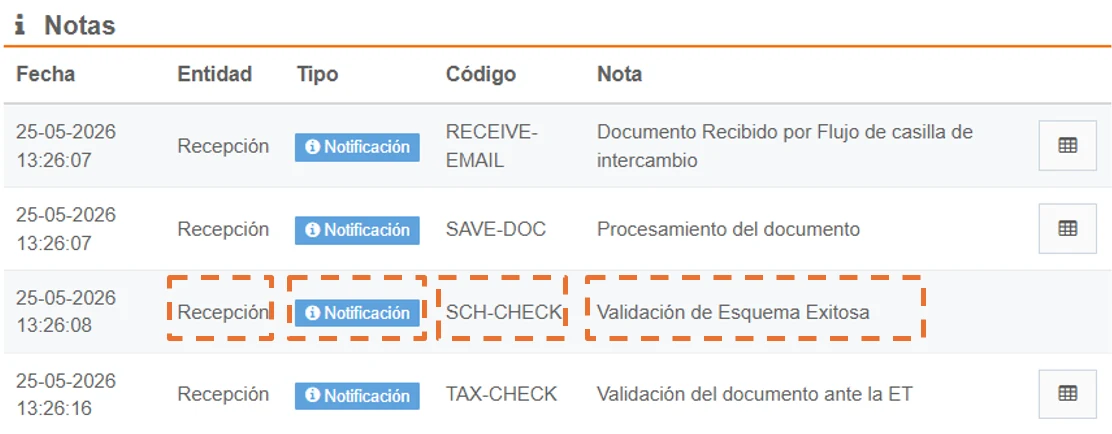
Document detail, Notes section - Successful schema validation
Special configuration: The XML has a schema error, but if the configuration is enabled, this option allows the reception flow to continue:
This feature can be enabled independently for each company. Its purpose is that, if a schema error is detected in the XML when the document is received in Gosocket, the specific error detail will be automatically recorded in the document's "Notes" section.
Despite this finding, the document will continue its normal flow toward the subsequent reception validations, such as signature verification and verification with the tax authority.
The document will remain in Inbox as follows:
- In Gosocket, the document will remain in Validated ET with schema error status and the orange icon
 will be displayed, as follows:

For more details on how to configure this feature, see the following section: XML Configuration Presents Schema Errors and Reception Flow Continues
4. Document electronic signature validation
Second, an electronic signature validation of the document is performed to ensure that the information has not been altered. This validation can produce one of the following results:
f. Failed: This means the document has been altered, the document reception flow will be stopped due to the signature error, so it will be registered in Gosocket with the Signature Error status, the interface will display an icon  and the preview notes will indicate the reason for rejection, as follows:

Signature error icon in Inbox
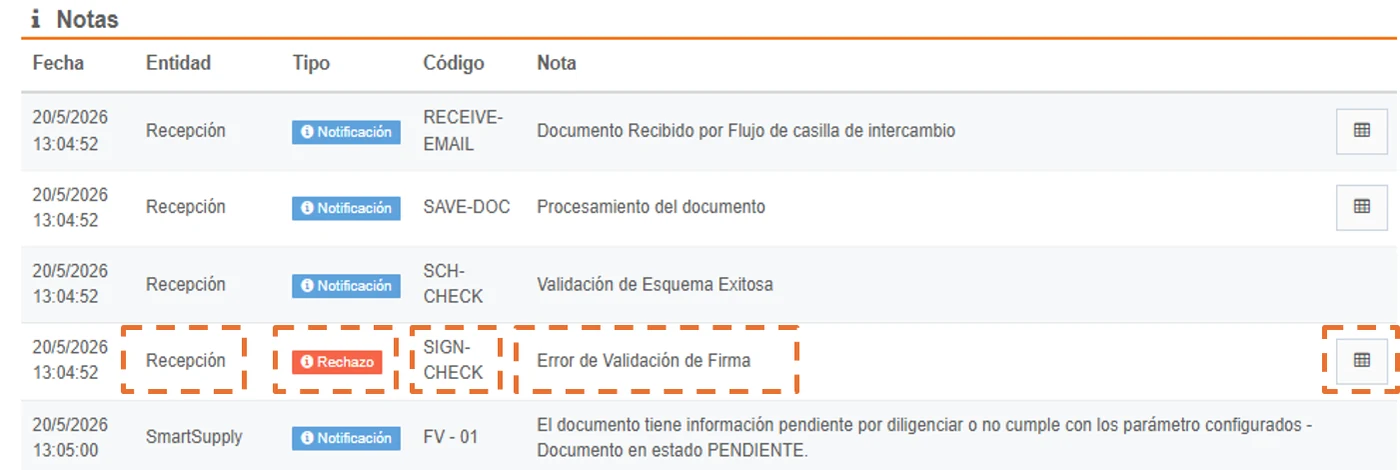
Document detail, Notes section - Signature Error
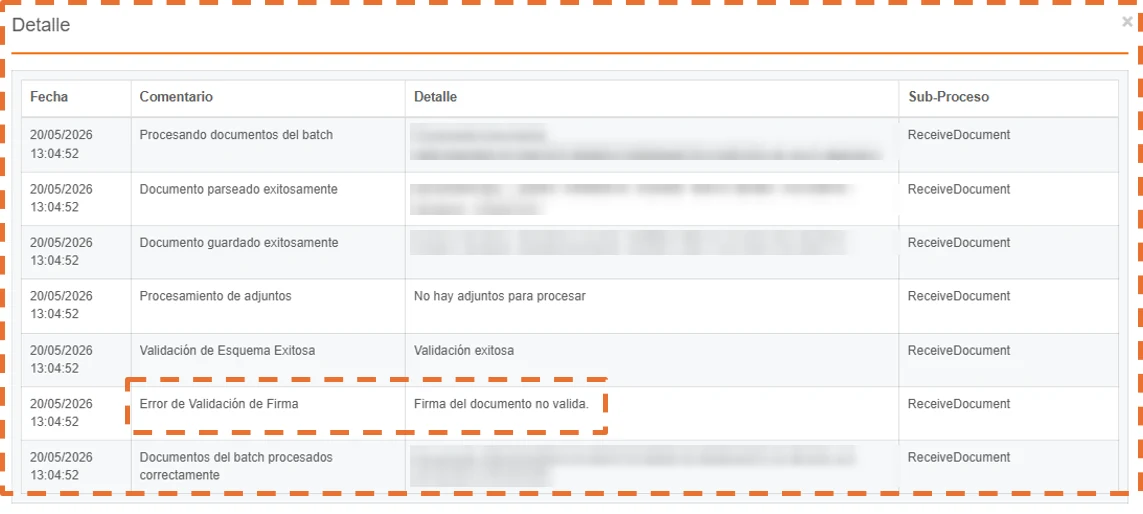
Detail of XML processing for the signature error
g. Successful: If the XML electronic signature validation is correct, the document will continue with the reception flow.
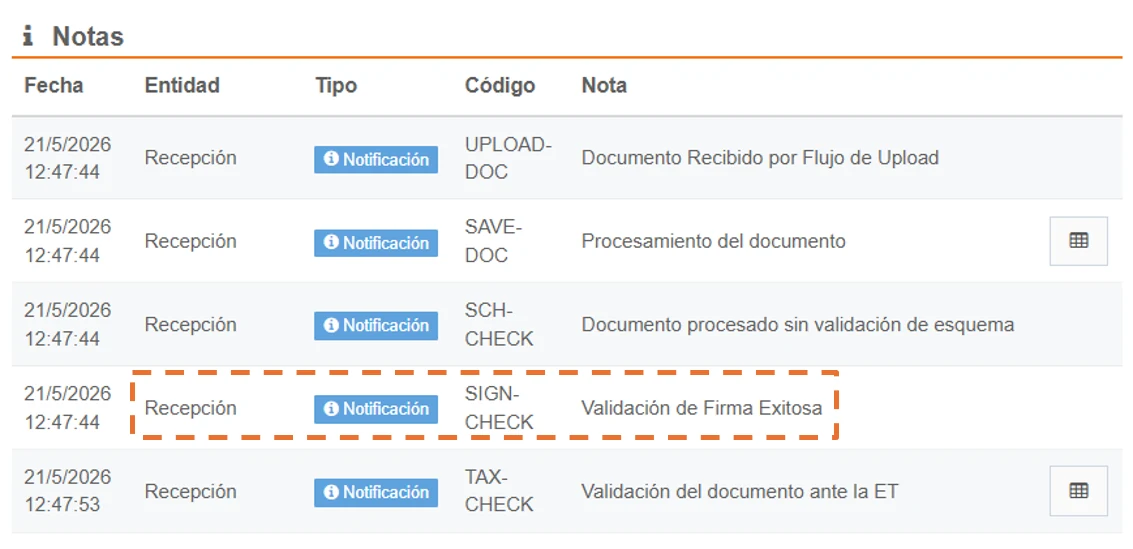
Document detail, Notes section - Successful signature validation
5. Inbox iconography for reception validation results
Finally, both the issuer and the recipient can view the results of the XML document validations in Inbox, as follows:
| No. | Status | Icon in the inbox interface |
|---|---|---|
| h | Document has a schema error | |
| i | Document has a signature error | |
| j | Document was Accepted by the Tax Authority |  |
2. MANUAL DOCUMENT REPROCESSING
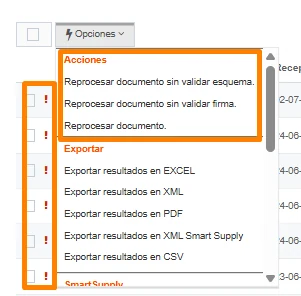
Additionally, a button was implemented in Inbox that allows manually reprocessing tax documents with Signature Error or Schema Error status.
Note: This option only allows reprocessing documents that were sent through the exchange mailbox, the reception API, or manual upload (upload).
This reprocessing option can be found in the following path, as applicable:
- Inbox/Received/Options/Actions/Reprocess document without validating schema.
- Inbox/Received/Options/Actions/Reprocess document without validating signature.
- Inbox/Received/Options/Actions/Reprocess document.
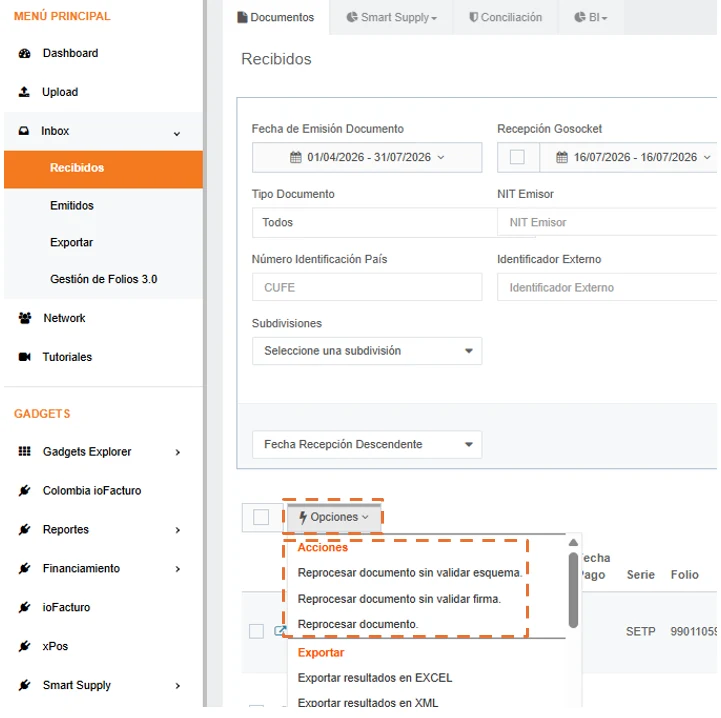
Accompanied by a selector that, as its name indicates, will allow selecting an Electronic Document or a set of them independently.
Next, a pop-up window will be displayed in which the user must confirm that they want to revalidate the previously selected documents.

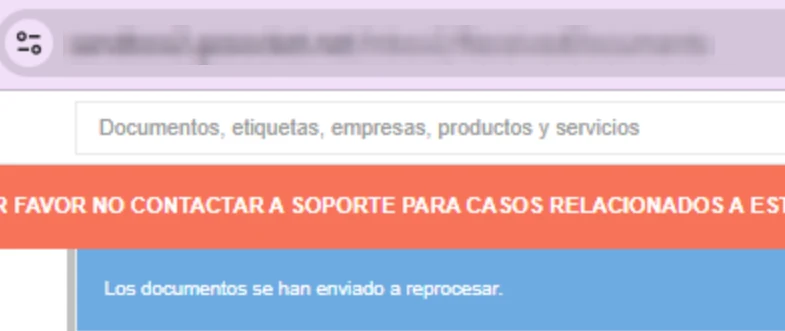
Once the reprocessing has been generated, a banner will be displayed at the top of the page indicating that the document(s) were sent for reprocessing:
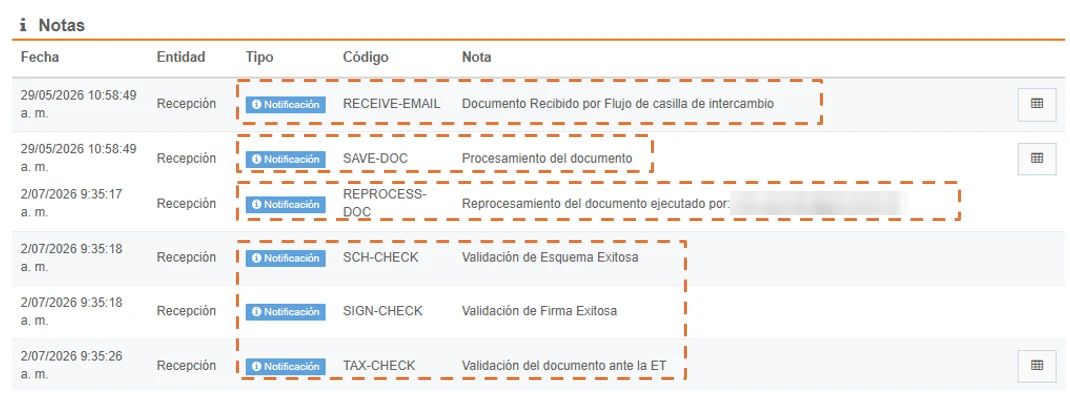
and finally, for any of the three reprocessing options generated through this option, the notes section will indicate:
- Records the email of the user who performed the document reprocessing.
- Generates a note “Document processed without schema validation” or “Document processed without signature validation”
- The document continues the reception validation flow.
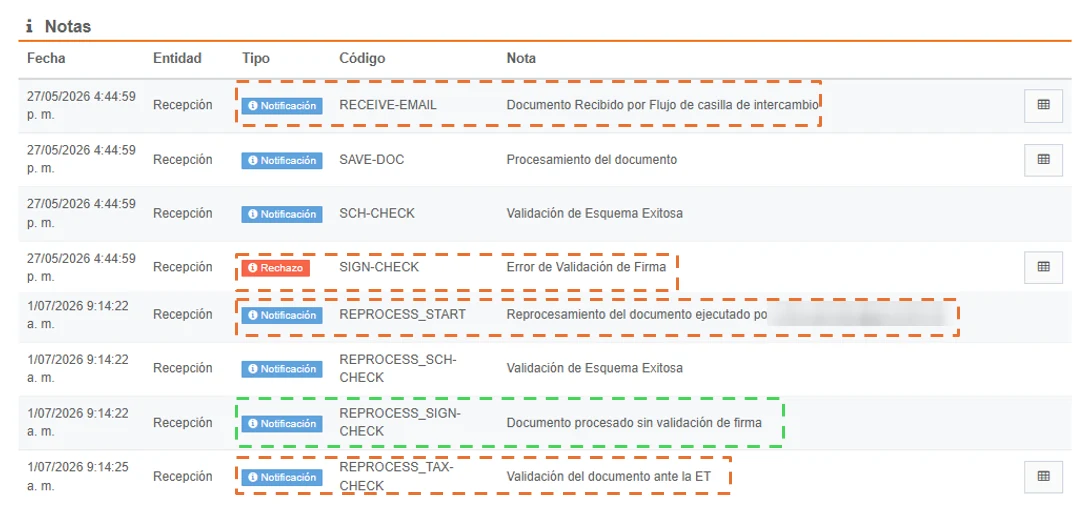
This button allows reprocessing of the different validations in the reception process:
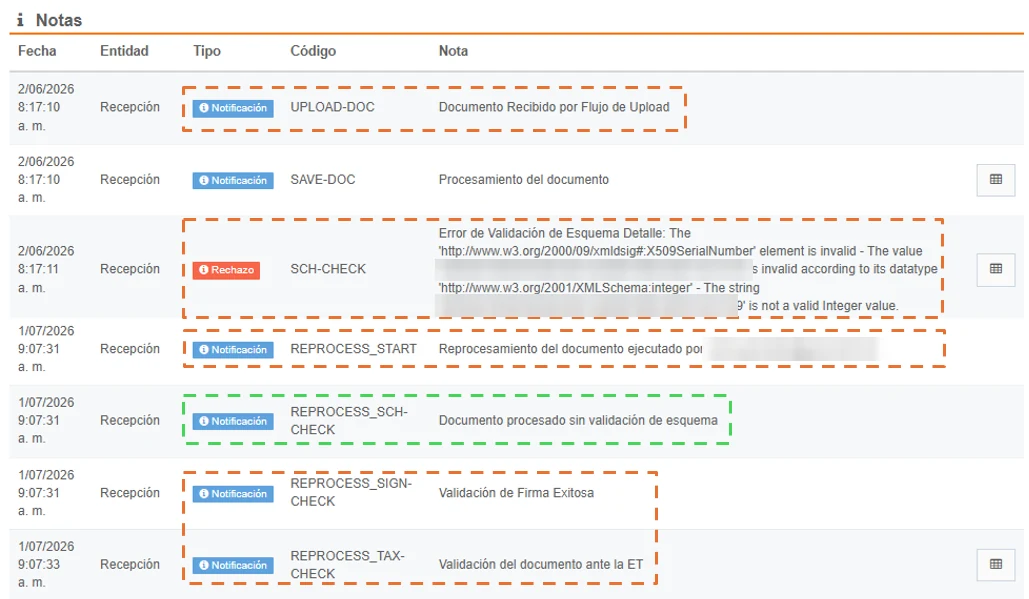
2.1. Reprocess document without validating schema:
Allows the document to go through the reception validations without taking the schema validation into account; however, when selecting the document and applying this reprocessing without schema validation, the system:
- Records the email of the user who performed the document reprocessing.
- Generates a note “Document processed without schema validation”.
- The document continues the reception validation flow.
2.2. Reprocess document without validating signature:
Allows the document to go through the reception validations without taking the signature validation into account; however, when selecting the document and applying this reprocessing without signature validation, the system:
- Records the email of the user who performed the document reprocessing.
- Generates a note “Document processed without signature validation”.
- The document continues the reception validation flow.
2.3. Reprocess document:
Allows reprocessing the document from scratch and performs the reception validations again without skipping any of them; however, when selecting the document and applying this reprocessing, the system:
- Records the email of the user who performed the document reprocessing.
- Performs the reception validations without skipping any of them.
3. METHODS FOR SENDING AN XML
Currently, there are three methods for document reception into the system:
- Manual upload: Import of the XML file using the Upload option in Gosocket.
- Exchange mailbox: Automated inbound flow through the exchange mailbox.
- Reception API: API connection for integrated processing.
3.1. Manual upload of the XML through Upload in Gosocket
Gosocket provides a tool within the Inbox platform that allows the supplier to directly upload the XML file of their documents.
- Access path: Main menu > Upload > Manual Upload.
From this section, the user can select the XML file from their device's file explorer or, if preferred, drag and drop it directly into the interface.
Once the document is received, the solution automatically starts the processing and validation flow.
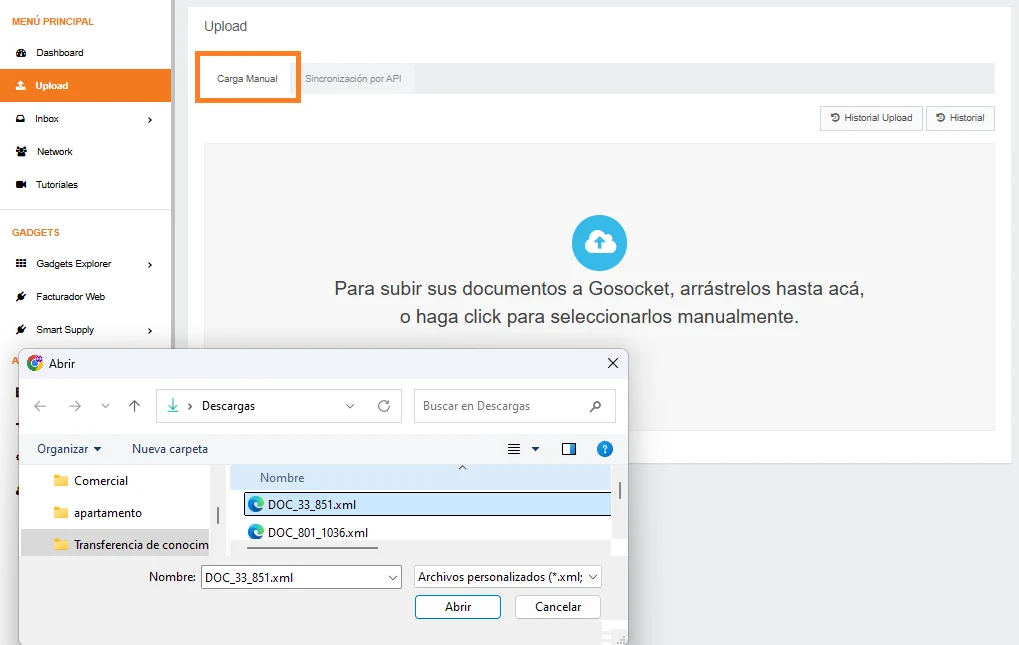
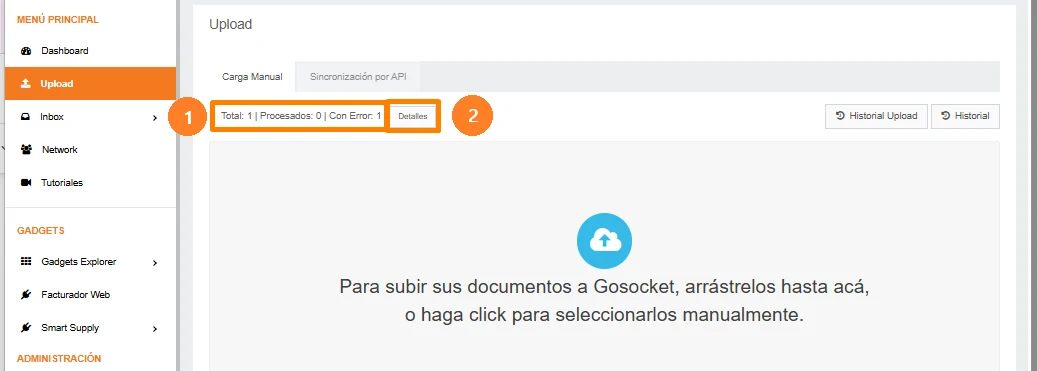
Once the XML file is received through the manual upload option, the following will be identified:
a. How many total XML files were received, how many were processed successfully, and how many have errors.
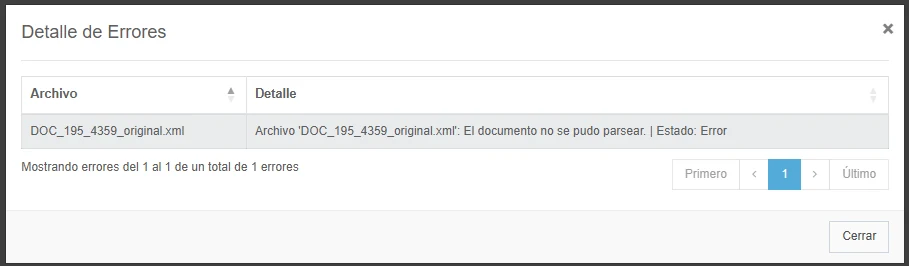
b. Clicking the “Details” button will display a popup with the “Error Details” identifying the possible errors that the XML file manually uploaded through this option may contain, and conversely, if the document has no errors, a detail will be displayed indicating that it was successfully uploaded to the Gosocket platform:
c. Finally, the document will be displayed in the Inbox received tray, with all validations completed.

3.1.1. Considerations for manual XML upload
- Up to 100 XML files can be uploaded in a single upload.
- Schema, signature, and Tax Authority validations will be performed.
- The tax documents stipulated by the Tax Authority must be sent in XML format.
The tax documents that can be received are:
- Internal Operation Invoice
- Import Invoice
- Export Invoice
- Credit Note referring to one or more electronic invoices
- Debit Note referring to one or more electronic invoices
- Generic Credit Note
- Generic Debit Note
- Free Trade Zone Invoice
- Reimbursement
3.2. Exchange mailbox
This is the process by which the supplier sends its XML files through an email mailbox. Each country has specific addresses assigned according to the work environment.
The mailboxes to be used, according to the environment, are:
- Sandbox (Testing):
pa_ms_sbx@inbound.gosocket.com - Production:
pa@recepcionprd.gosocket.net
3.2.1. Considerations for the exchange mailbox
It is important to keep the following points in mind when sending documents, as this will prevent them from being rejected by the application.
a. The tax documents that can be sent through the exchange mailbox are:
- Internal Operation Invoice
- Import Invoice
- Export Invoice
- Credit Note referring to one or more electronic invoices
- Debit Note referring to one or more electronic invoices
- Generic Credit Note
- Generic Debit Note
- Free Trade Zone Invoice
- Reimbursement
b. The tax documents stipulated by the Tax Authority must be sent in XML format.
c. They can be sent individually or as several XML files in the same email.
d. Several XML files can be sent compressed in a file, and only the .zip extension is allowed.
e. The XML or compressed (.zip) files must be attached to the email sent to the mailbox provided by Gosocket.
f. Attached documents can be sent, such as the invoice PDF or others as required.
g. The maximum size allowed for an email containing XML and PDF files is 20MB.
h. The solution is able to process the graphic representation PDF, if it is included, and attached documents that arrive at the mailbox, which, once received, are stored and associated with their respective document, allowing them to be downloaded within Inbox.
The process works as follows:
- If an XML document arrives at the exchange mailbox along with an additional PDF file with the same name, for example: Factura12345.xml and Factura12345.pdf, the .pdf file is understood to be the graphic representation of the DTE, so it is synchronized that way in Gosocket and will be available for query.
- If an XML document arrives at the mailbox with more than one attached file of any extension, they are associated as attached documents.
Note: If there are PDF files with a name different from the XML, they will be considered attached documents.
- For sending attachments, it is recommended to send each DTE with its attachments separately, since if more than one XML document arrives, only the graphic representation will be stored, provided that the PDF file has the same name as the corresponding XML; the rest of the attached files will not be processed since there is no way to know which document to associate them with.
- Attachments can also be associated after the XML has been sent; for example, if the XML is sent without attachments, another email with attached documents (PDF, Excel, Word, etc) can be sent afterward, and these will be associated with the previously sent document, as long as the second email also includes the XML.
3.3. Reception API's
For the document reception process, Gosocket offers two API's that allow sending XML to the Gosocket platform:
3.3.1. UploadZipDocument:
This API allows sending a request that includes one or several XML and PDF files to Gosocket, packaged together in a compressed file (.zip). Once received, the system processes the document, generates the corresponding record, and securely stores it on the platform.
a. Tracking Management (Tracking)
To perform detailed end to end tracking of PDF processing, from the moment the PDF enters the platform through the exchange mailbox, until the supplier sends the XML and the PDF to Gosocket, this entire process is assigned two unique identifiers called "externalId" and "batchId".
b. Upload and storage
The API manages the reception of the .zip file, which must contain the PDF and its corresponding XML in Gosocket's native format for correct integration into the ecosystem.
This API allows the reception, processing, and storage of electronic documents on the Gosocket platform.
c. Post-storage processing actions
Once the document has been successfully stored in Inbox, the following actions can be performed:
- Reception validations (Automatic): Technical verification of standards compliance, including:
o Schema validation.
o Integrity of the document's Electronic Signature.
o Validations with the corresponding Tax Authority: Indicates whether the document was accepted, rejected, or has validation errors from the regulatory entity after fiscal validation.
- Receiver message (Automatic): Application of receiver message events according to the tax authority's current regulations.
- Smart Supply validations (On-demand configuration): Application of logical rules and approval flows configured in the Smart Supply module.
- File Distribution (On-demand configuration): Once the document has been processed on the Gosocket platform, and based on the previously configured parameterization of the distribution rules, the system executes the automated transfer of files to the configured technical destinations. This feature allows integration with various environments, such as:
o Windows servers.
o File transfer protocols (SFTP / FTP).
o Automated sending by email.
You can review the configuration details of the Reception API at the following link: API Reception.zip - Generic
3.3.2. SendDocumentToUpload:
This API allows sending a request that includes a single XML to Gosocket. Once received, the system processes the document, generates the corresponding record, and securely stores it on the platform.
a. Upload and storage
The API manages the reception of the file in XML format for its integration into the Gosocket ecosystem:
- Ingestion: Uploads the document directly into the Inbox module of Gosocket through the endpoint: POST - SendDocumentToUpload
- Persistence: Ensures the storage of the XML file on the platform's servers for subsequent management.
b. Tracking Management (Tracking)
The successful execution of the API generates a unique identifier called trackId. This value is returned in the response and is essential for:
- Performing detailed tracking of the processing status.
- Checking the upload result through the endpoint: GET- GetDocumentUploadStatus
c. Post-storage processing actions
Once the document has been successfully stored in Inbox, the following actions can be performed:
- Reception validations (Automatic): Technical verification of standards compliance, including:
o Schema validation.
o Integrity of the document's Electronic Signature.
o Validations with the corresponding Tax Authority: Indicates whether the document was accepted, rejected, or has validation errors from the regulatory entity after fiscal validation.
- Receiver message (Automatic): Application of receiver message events according to the tax authority's current regulations.
- Smart Supply validations (On-demand configuration): Application of logical rules and approval flows configured in the Smart Supply module.
- File Distribution (On-demand configuration): Once the document has been processed on the Gosocket platform, and based on the previously configured parameterization of the distribution rules, the system executes the automated transfer of files to the configured technical destinations. This feature allows integration with various environments, such as:
o Windows servers.
o File transfer protocols (SFTP / FTP).
o Automated sending by email.
You can review the configuration details of the Reception API at the following link: Reception API
4. QUERYING RECEIVED DOCUMENTS FROM GOSOCKET
Once the documents have been processed by the reception service, they can be viewed from the Gosocket portal in the Inbox/Received section. **
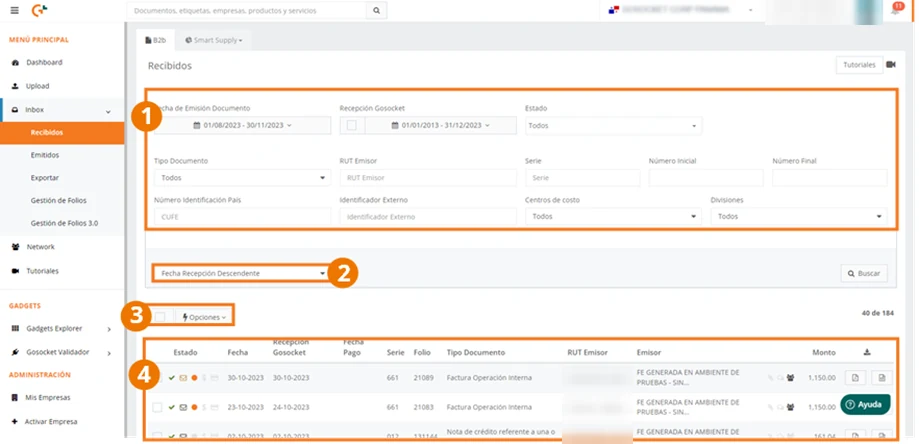
This section displays the following screen:
**1.**Filters section to optimize the search results. **
**2.**Sort order control, which allows you to modify how the search results are displayed. **
**3.**List of options related to export, commercial responses, and internal movements of the Electronic Documents. **
**4.**Display section with the search result details and representative iconography of the most relevant status changes. **
* For more information on these points, see the Inbox documentation.**
Once the document search is performed in the main grid, the list of received documents that met the established search criteria will be displayed; in this grid, in addition to relevant document information, the document's status can also be observed.

**1.**Tax authority validation.
**2.**Distribution validation.
**3.**Smart Supply status validation.
The status column (1) will display the result of the validations applied, as explained in the section XML reception process.
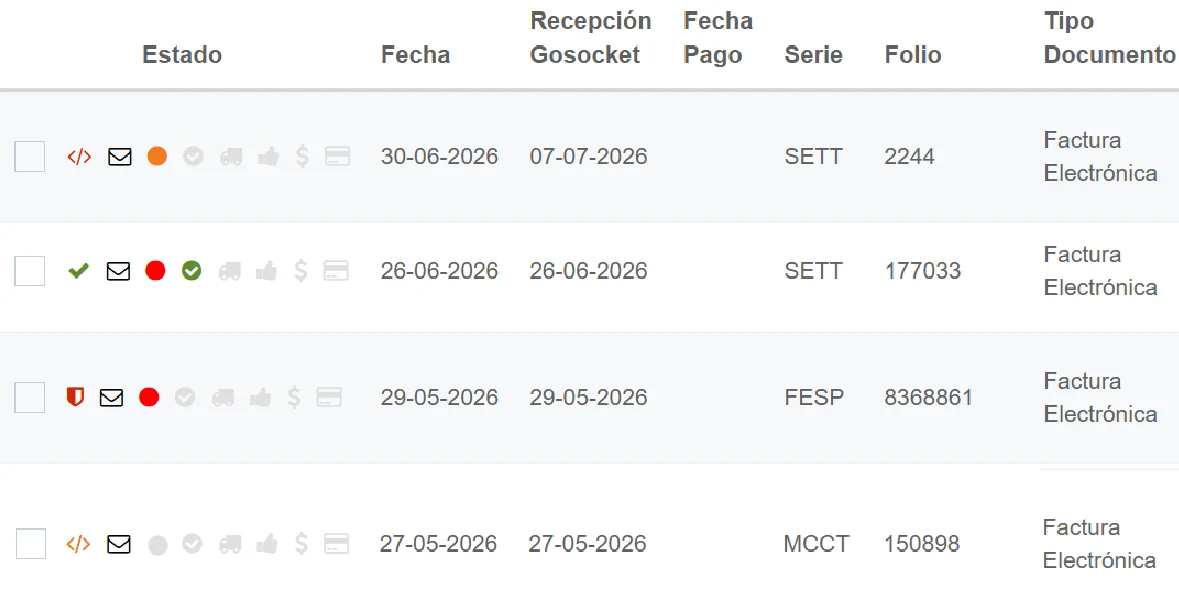
| Icon | Status | Validation |
|---|---|---|
 | VALIDATED | Document approved by the TA |
| * | Signature Error | Document with signature error |
| * | Schema Error | Document with schema error |
| ** | Schema error but the flow continues * | The XML has a schema error, but if the configuration is enabled, this option allows the reception flow to continue. |
* Note: Clicking on the document will open the document preview where you can review the notes related to the reason for schema rejection or signature rejection.

* Note: Special configuration: The XML has a schema error, but if the configuration is enabled, this option allows the reception flow to continue:
This feature can be enabled independently for each company. Its purpose is that, if a schema error is detected in the XML when the document is received in Gosocket, the specific error detail will be automatically recorded in the document's "Notes" section.
Despite this finding, the document will continue its normal flow toward the subsequent reception validations, such as signature verification and verification with the tax authority.
The document will remain in Inbox as follows:
- In Gosocket, the document will remain in Validated ET with schema error status and the orange icon will be displayed, as follows:
For more details on how to configure this feature, see the following section: XML Configuration Presents Schema Errors and Reception Flow Continues